
Waraseoni Sarees: History and Heritage of Madhya Pradesh
A town where history is held together by warp and weft
Waraseoni is a small town in Madhya Pradesh's Balaghat district, set beside the flowing waters of the Wainganga River. It is not a large place, but for over two and a half centuries the rhythmic clack of wooden looms has echoed through its neighbourhoods. What came off those looms is far more than a garment: it is a fabric carrying community history, mythology and a level of craftsmanship that is genuinely rare.
The Waraseoni saree goes by several names in the market, including Wainganga cotton and the traditional sixteen-hand drape. The Wainganga Cotton Saree received a Geographical Indication tag in 2023, making it one of Madhya Pradesh's recognised handloom traditions.
Two artisan lineages
The weaving tradition is sustained by two communities, and their names describe exactly what they work with. The Koshtis take their name from Kosa, the regional word for raw tussar silk that gives Waraseoni drapes their characteristic textured sheen. The Salewars trace their name to the Sanskrit word Salika, meaning the art of weaving itself.
Both draw on strong Marathi roots along the Madhya Pradesh border, and it is that combination of wild silk and generational handloom expertise that produces the distinctive drape. Today weavers work in cotton, silk and silk-cotton blends, alongside regional traditions such as Chanderi and Maheshwari.
The Markandi legend and the tiger
Step into a weaver's home in Waraseoni and you may be told the story of the Koshti community's origins. Local folklore holds that the community traces itself to Saint Markandi Rishi, believed to have been the first to weave cloth from the delicate fibres of the lotus flower as an offering to the gods.
The legend continues that the Sun God, Surya, was pleased with Markandi's devotion and gave him his daughter in marriage. As part of the wedding gift, Markandi received a loyal tiger and a giant named Bhavani. When Bhavani disobeyed him, Markandi defeated him and is said to have fashioned the world's first loom from the giant's bones. The tiger, however, stayed faithful.
This story is respected rather than treated as decoration. The Koshtis hold that tigers recognise them as descendants of Markandi and will not harm them, and it is said a weaver who meets a tiger in the forest can call out Markandi's name and the animal will leave peacefully. Because of this bond the community traditionally does not harm tigers. At weddings, families also worship a sacred scroll called the Padgia, which carries a painting of a tiger.
Measuring in hands, not on rulers
Waraseoni sarees are traditionally woven as sixteen-hand drapes, and the measurements are taken with the body rather than a standard ruler. An Ekungal is one finger's breadth, a Teen ungal three fingers, an Ekbhitha a hand span and an Ekhaath the distance from elbow to fingertip. The same logic shapes the borders: the Ekbhithakinar is a hand-span-wide border designed to cover the head.
Colours, borders and checks
The colour palette is taken from ordinary objects and the natural world. Baingani is eggplant purple, Gulabi rose pink, Eent brick red, Pyaazi onion-peel violet, Firozi turquoise, Mehndi henna and Aasmaani sky blue.
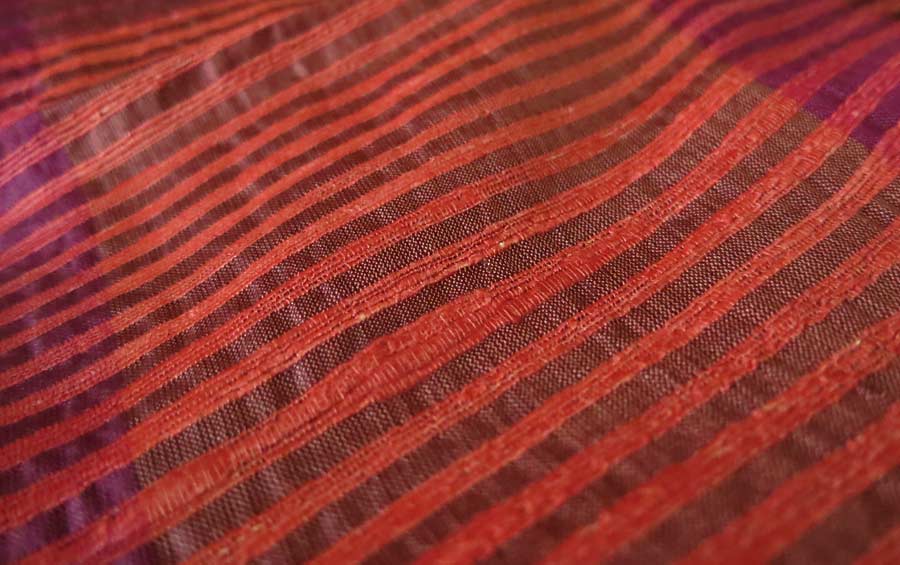
Borders are what separate a Waraseoni drape from a plain cotton saree. The Nakshikinar is a deep red border worked with delicate floral and vine motifs, with traditional designs including Ruiphool, Chatai Kinar, Machli Kanta, Gom and Leheriya. Stripes include Selari, which is made of simple uniform lines, and Bhaga, which carries colourful changing stripes. Checks come in Moongia, woven at four inches, and Mukhtiya, a smaller two-inch check worked with two shuttles.
Specialities and ceremonial weaves
The Reshmijote pairs a sturdy cotton body with a two-ply silk border, using enough silk to conceal the cotton threads and give a refined finish. Among ceremonial pieces, the Anjari, or Aanjanasaree, is an all-silk wedding saree with red borders and Cheechpopdi motifs inspired by lentils, and it deliberately avoids pure black. The most prized is the Pitambari Aanjana, which has a bright yellow body, a saw-toothed Gom border and zari work, and is often kept as a family heirloom.
Why the craft survived
The tradition flourished under the patronage of Raja Raghuji Bhonsle around 1900 AD, when local weavers were producing fine dhotis and drapes in counts ranging from 10s to 100s. Proximity to the Maharashtra border brought strong Maharashtrian influence, which helped build Waraseoni's reputation for ultra-fine cotton. Tussar silk cultivation continues to support local and tribal livelihoods, and the handloom economy remains the reason the town's identity has stayed intact.
To see the craft working rather than behind glass, visit Balaghat and spend time with the Koshti weavers. The looms are still there, and the sound of them is still the sound of Waraseoni.
Planning your own trip
Planning the trip yourself and weighing up hotels, cabs and the order in which to see the sights? Shrimm Tours & Travels can walk you through the options for Madhya Pradesh and the districts around it, and tell you what actually fits the days you have. It costs nothing to ask first. See what they can arrange before you book anything yourself.
What is a Waraseoni saree?
A Waraseoni saree is a handloom weave from Waraseoni in Balaghat district, Madhya Pradesh. It is also known as Wainganga cotton or a traditional sixteen-hand saree, and the Wainganga Cotton Saree received a Geographical Indication tag in 2023.
Who are the Koshti and Salewar weavers?
They are the two artisan lineages behind the Waraseoni handloom. The Koshtis take their name from Kosa, the regional term for raw tussar silk used in the drapes. The Salewars derive their name from the Sanskrit word Salika, meaning the art of weaving itself.
What is the Markandi Rishi legend?
Local folklore holds that the Koshti community descends from Saint Markandi Rishi, the first to weave lotus fibre for the gods. Legend says Surya gave him his daughter in marriage, and that Markandi fashioned the world's first loom from the bones of a giant named Bhavani. The community believes tigers will not harm them.
How are Waraseoni sarees traditionally measured?
Artisans use human proportions rather than rulers. Measurements include the Ekungal, one finger's breadth, the Teen ungal, three fingers, the Ekbhitha, a hand span, and the Ekhaath, elbow to fingertip. These also shape borders such as the Ekbhithakinar, designed to cover the head.
What are the signature borders and motifs?
The Nakshikinar is a deep red border with floral and vine motifs, with designs such as Ruiphool, Chatai Kinar, Machli Kanta, Gom and Leheriya. Stripes include Selari and Bhaga. Checks include the four-inch Moongia and the two-inch Mukhtiya, which is woven with two shuttles.
Which Waraseoni saree is kept as a family heirloom?
The Pitambari Aanjana is the most prized ceremonial weave. It has a bright yellow body, a saw-toothed Gom border and zari work, and is typically preserved as a family heirloom.
Source: Madhya Pradesh Tourism. Compiled from the Madhya Pradesh Tourism page of the same name; figures and place names are as given there.
